Firing, refusal and deterministic replay
Packaged execution captures exercise the governed firing path, preserve typed refusal rather than inventing a value, and demonstrate byte-identical replay on a named event sequence.

These are selected captures from the running Kindynos applications and reproducible execution artifacts behind them—not a catalogue of aspirations. The current public edition is deliberately path-specific while the broader capability-by-world evidence map is being completed.
Kindynos spans many authored worlds and many analytical capabilities. A function that works in one ecosystem, version or event path is not automatically claimed for every other one.
For the screenshots below, the claim is simple: the named surface rendered in the named world at capture time. Stronger computational claims are supported separately by execution artifacts and the technical register.
Captured directly from the running EVA interface on 7 August 2026. These examples show actual application state across US Housing v9, Global Equity, Global Buildings and Global Insurance v3.
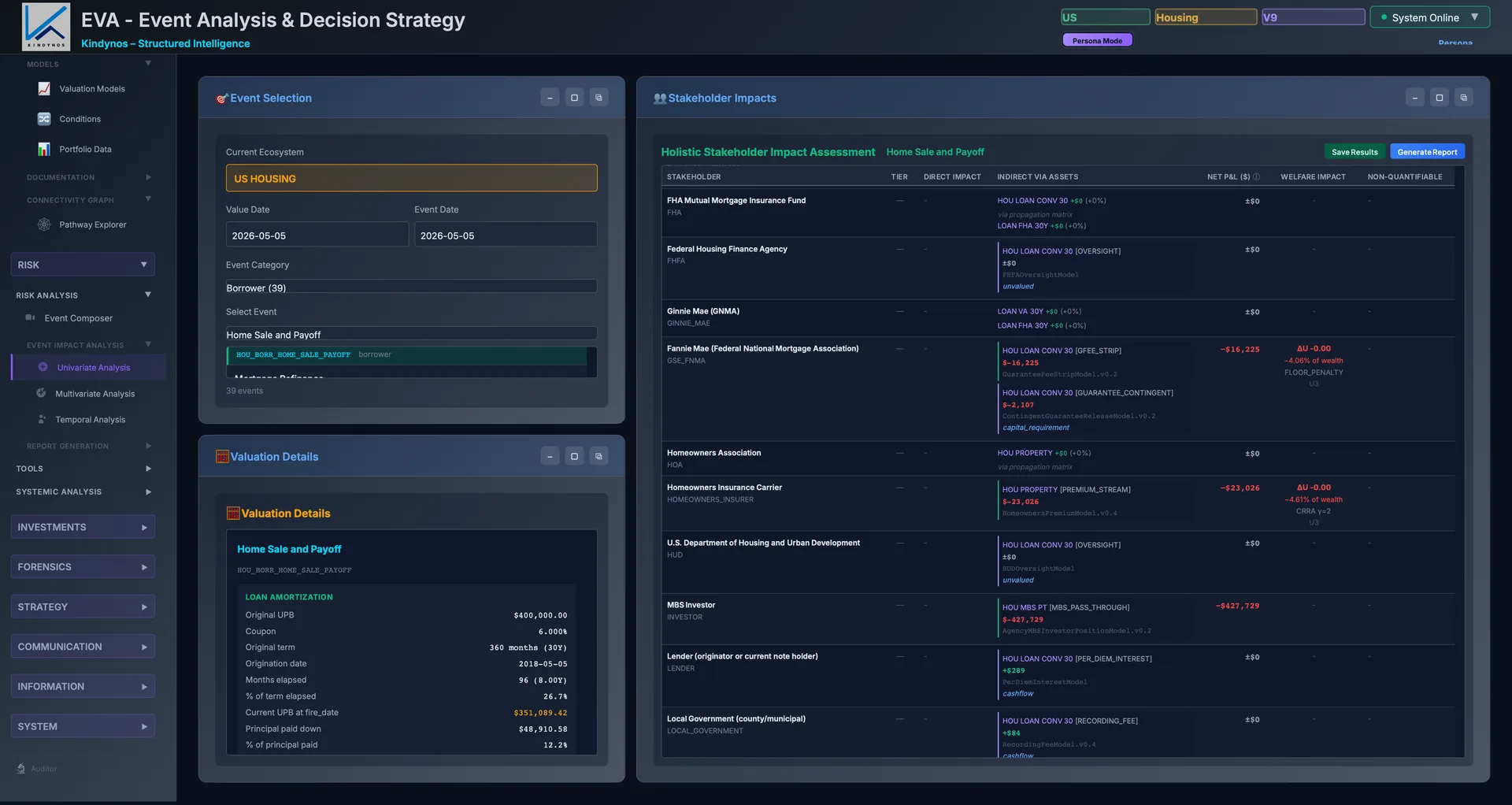
One selected event is carried through valuation details into stakeholder-specific financial consequences, preserving the model path and typed status for each row.
Open full capture ↗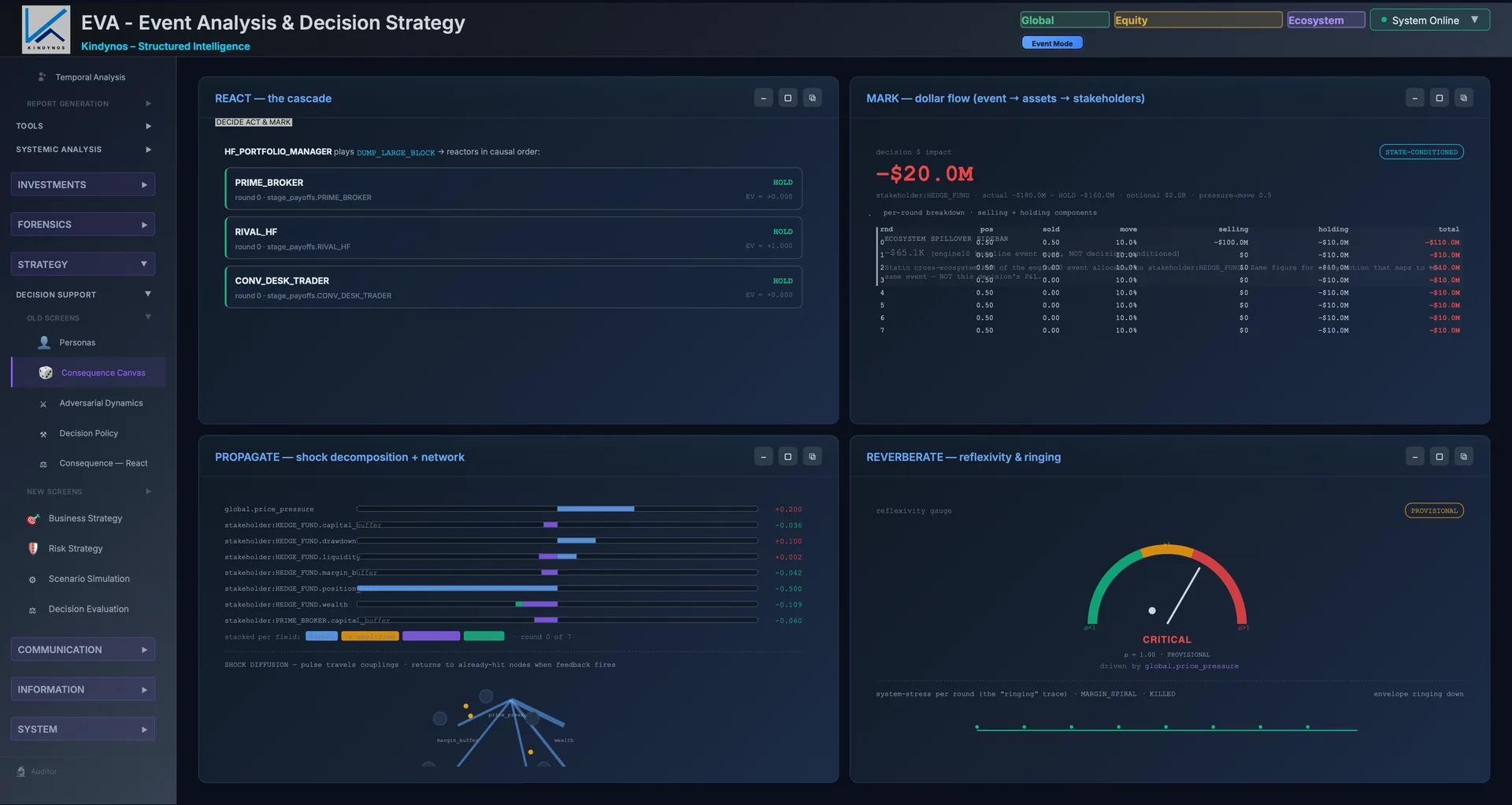
A decision path is shown through reactive actors, dollar consequences, state-conditioned propagation and a reflexivity view rather than as a single static score.
Open full capture ↗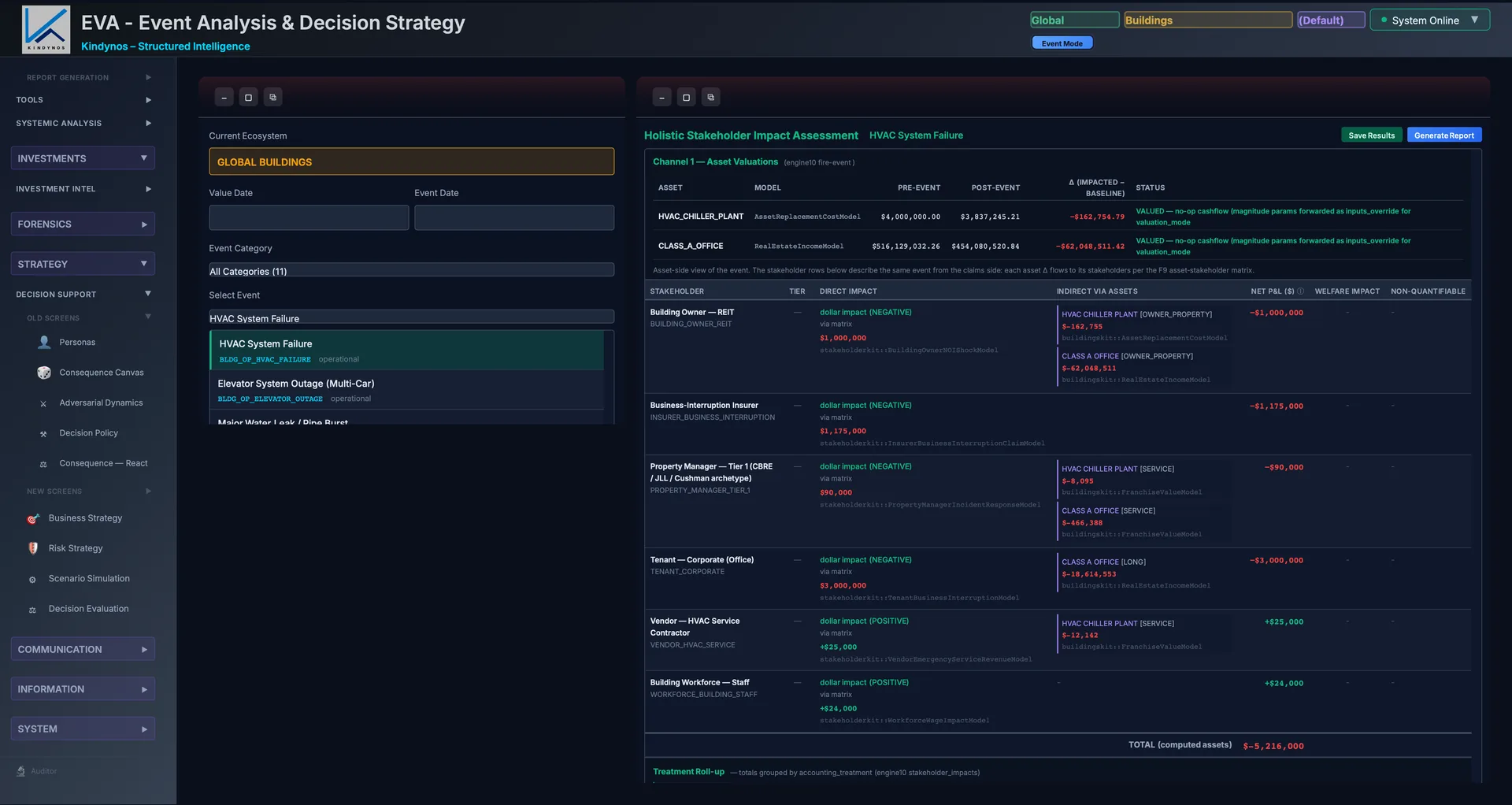
Asset revaluation and direct stakeholder channels appear together for the building owner, insurer, property manager, tenant, service vendor and workforce.
Open full capture ↗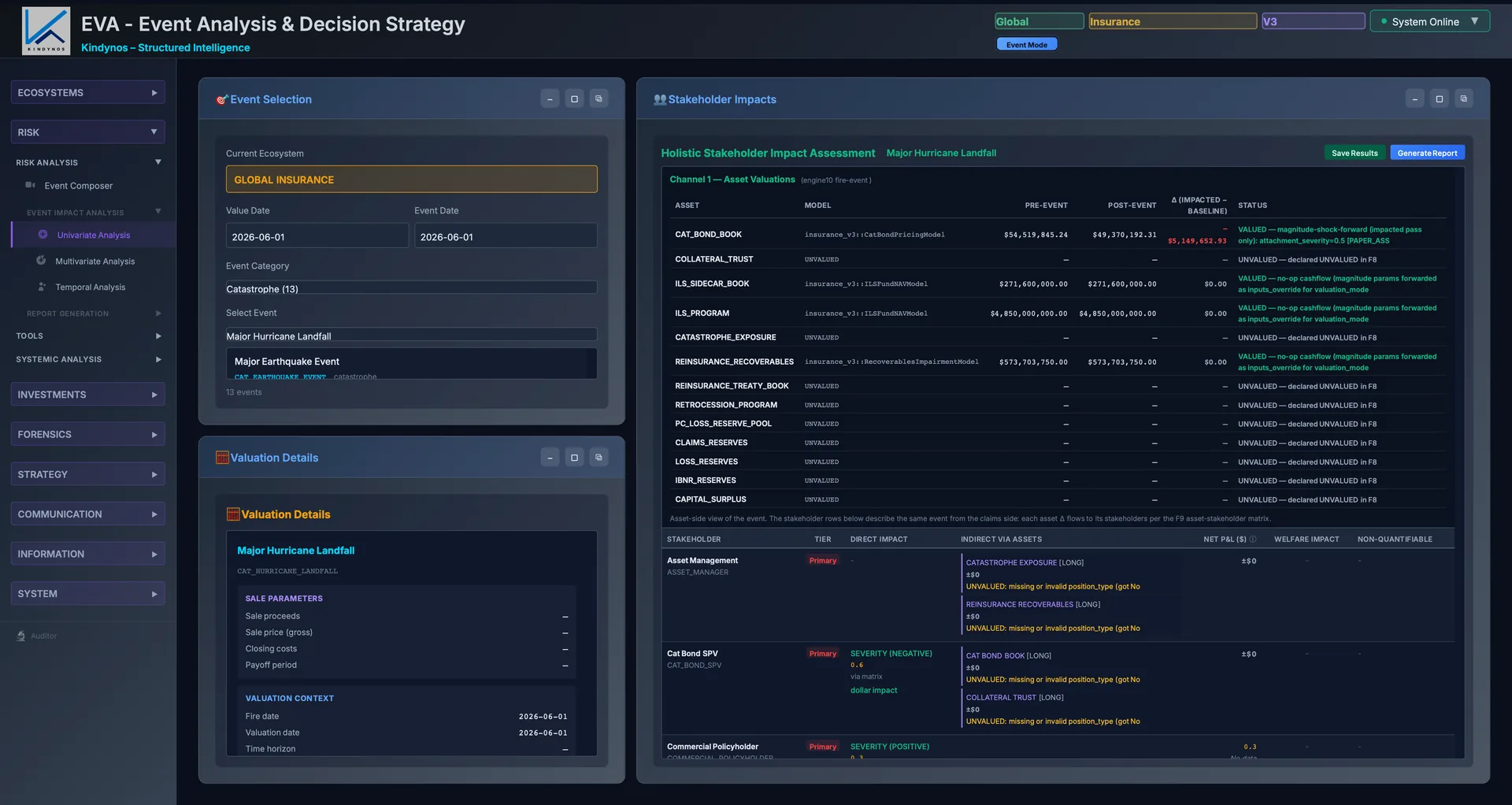
The same screen contains valued model paths and explicit UNVALUED paths. Missing coverage is visible rather than silently converted into a number.
Open full capture ↗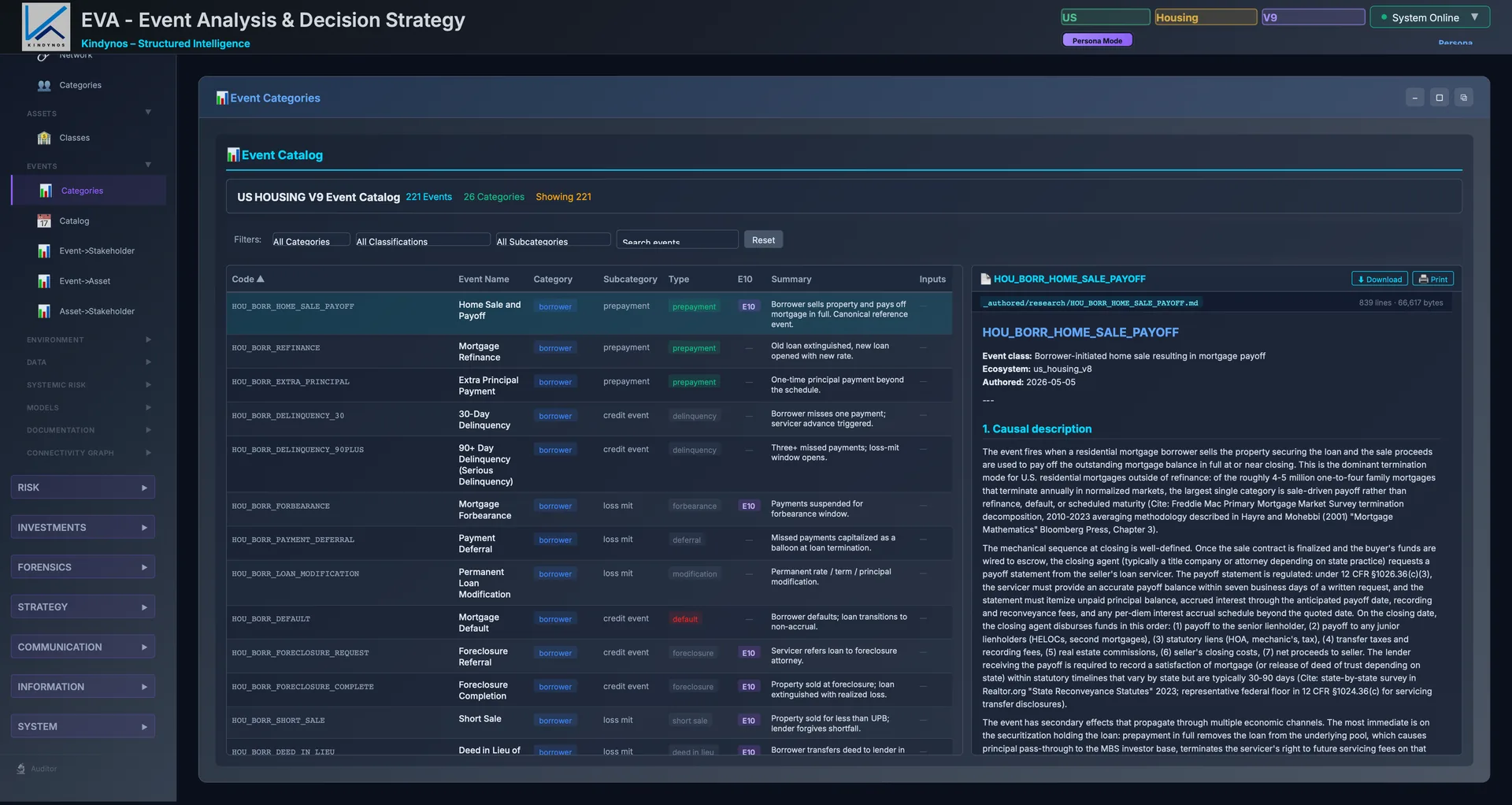
The captured world exposes 221 events across 26 categories; the selected Home Sale and Payoff event opens its authored causal description alongside the catalogue.
Open full capture ↗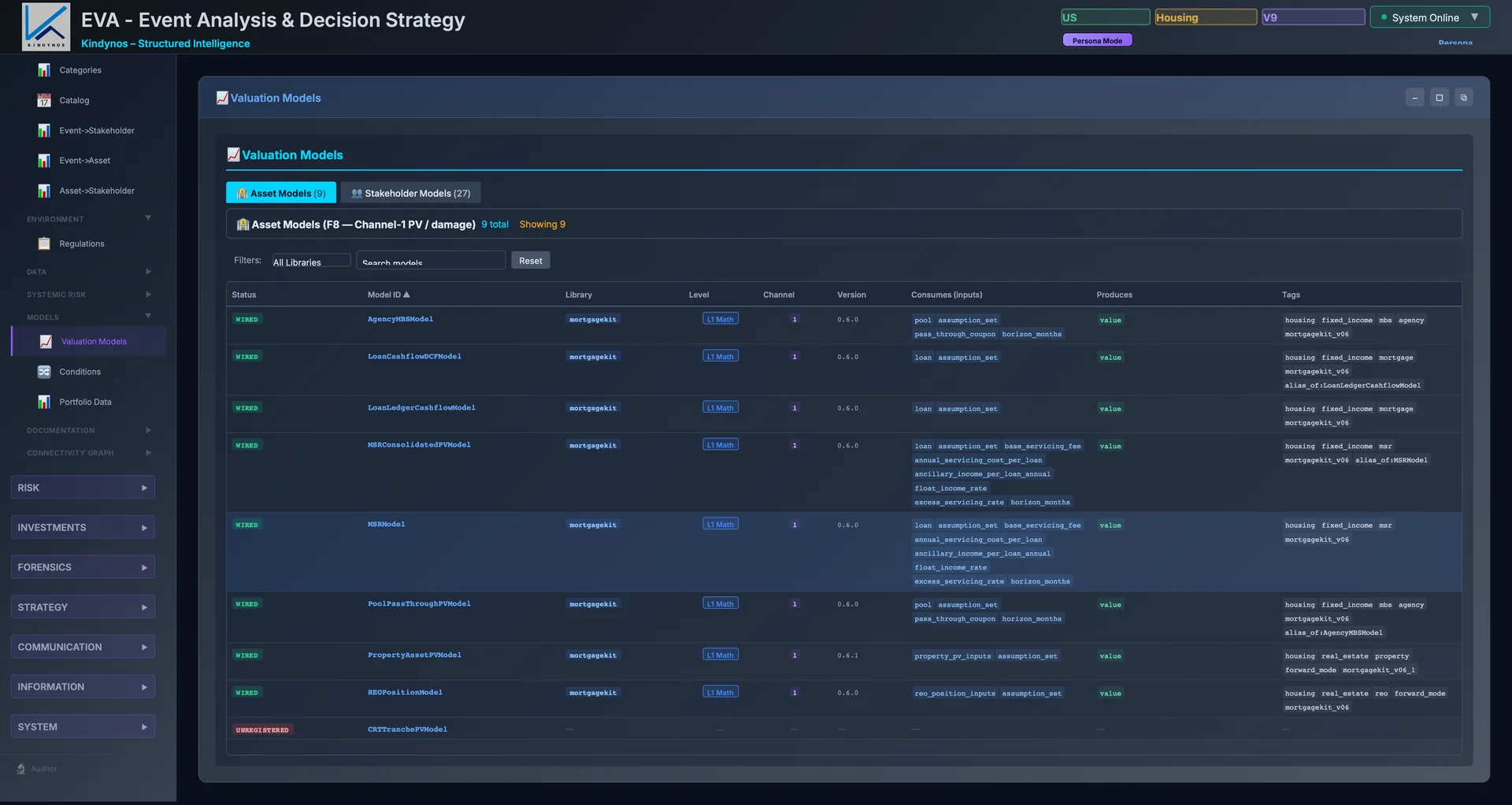
The valuation-model surface shows model identity, library, level, version, inputs and outputs—and visibly distinguishes WIRED coverage from an UNREGISTERED model.
Open full capture ↗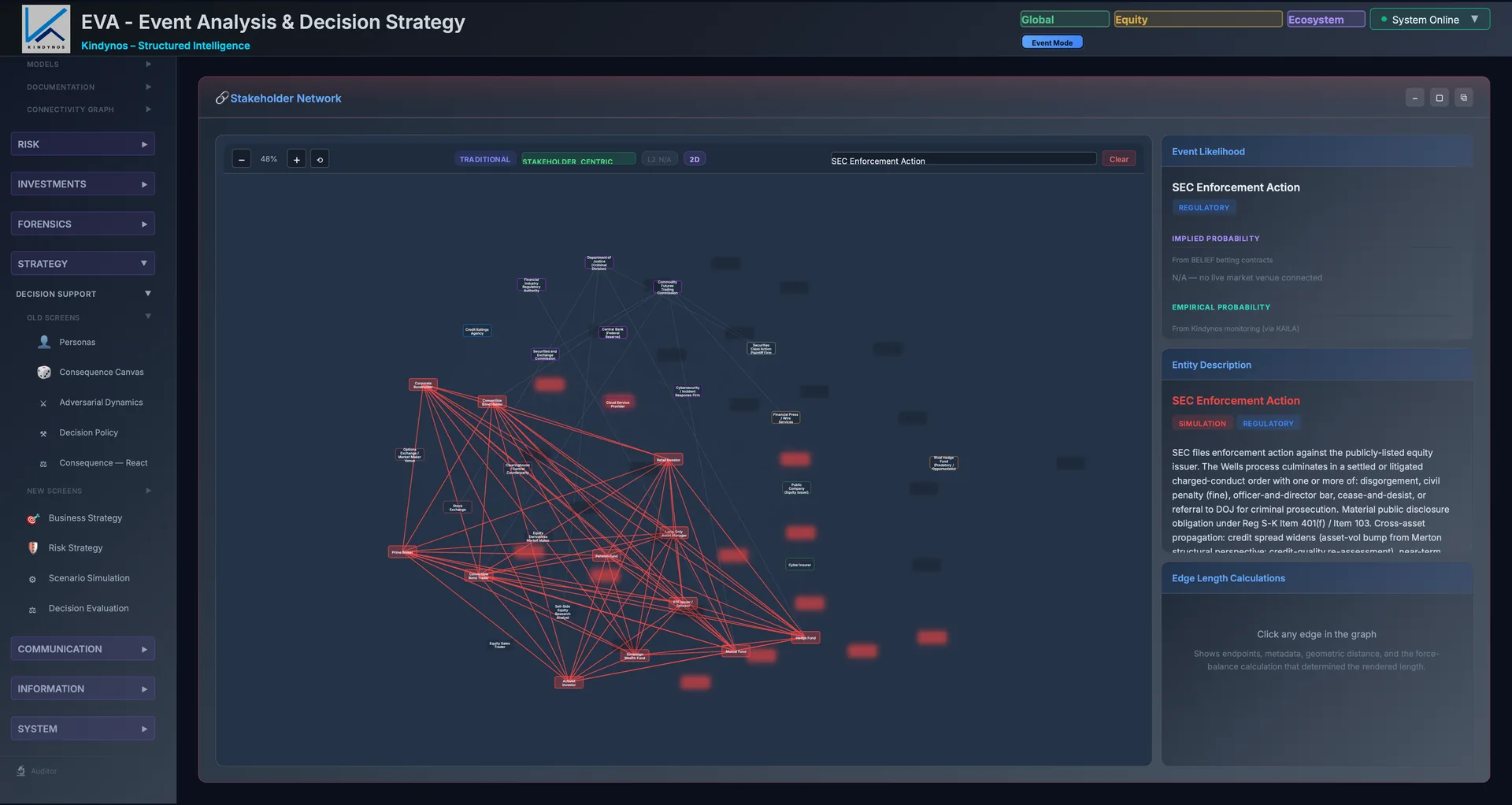
The SEC Enforcement Action is placed inside the equity-world relationship graph, with event description and affected network structure available in the same operator surface.
Open full capture ↗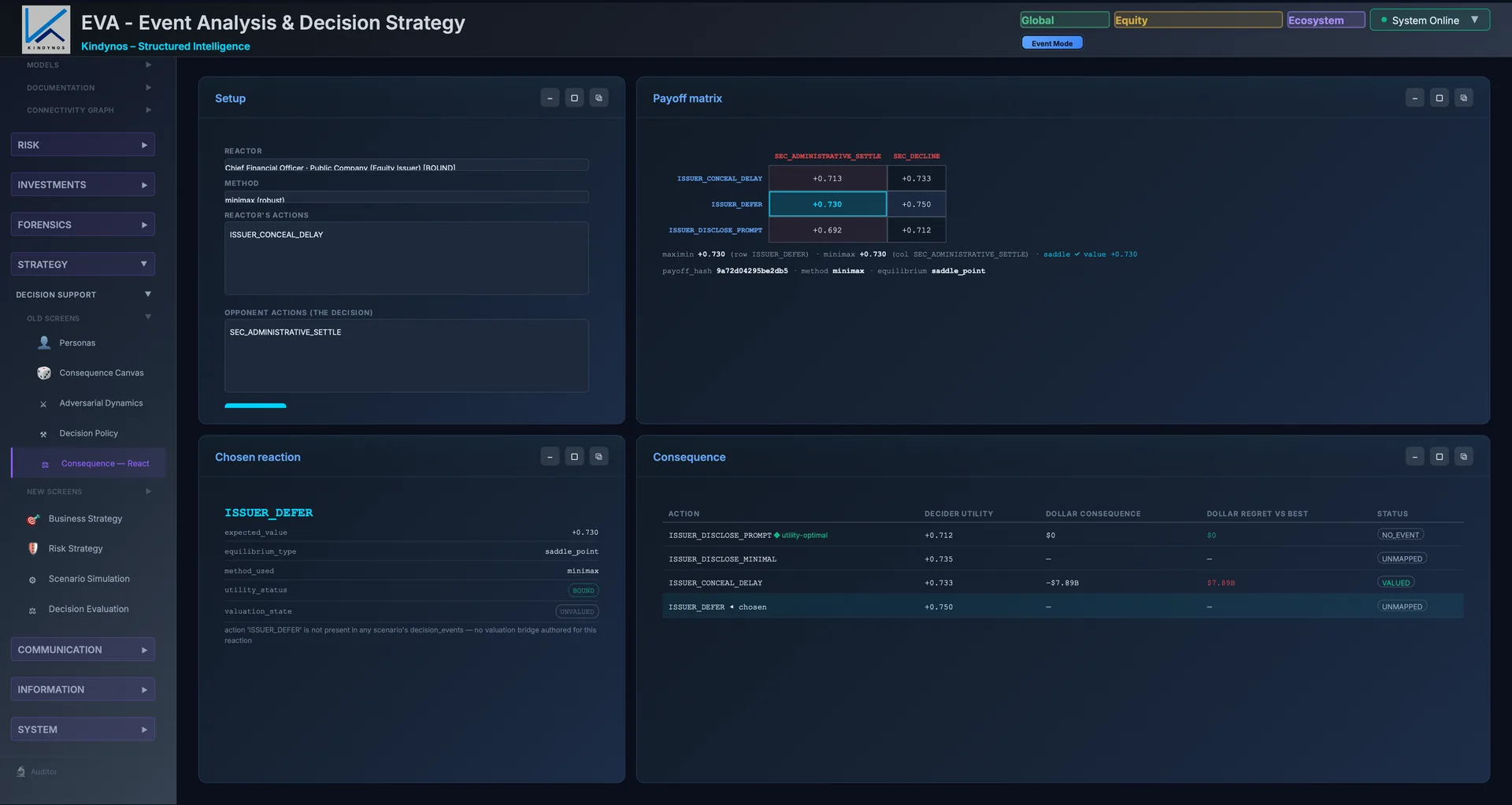
A minimax decision selects a reaction from the payoff matrix while the consequence panel separately shows which action outcomes are VALUED, NO_EVENT or UNMAPPED.
Open full capture ↗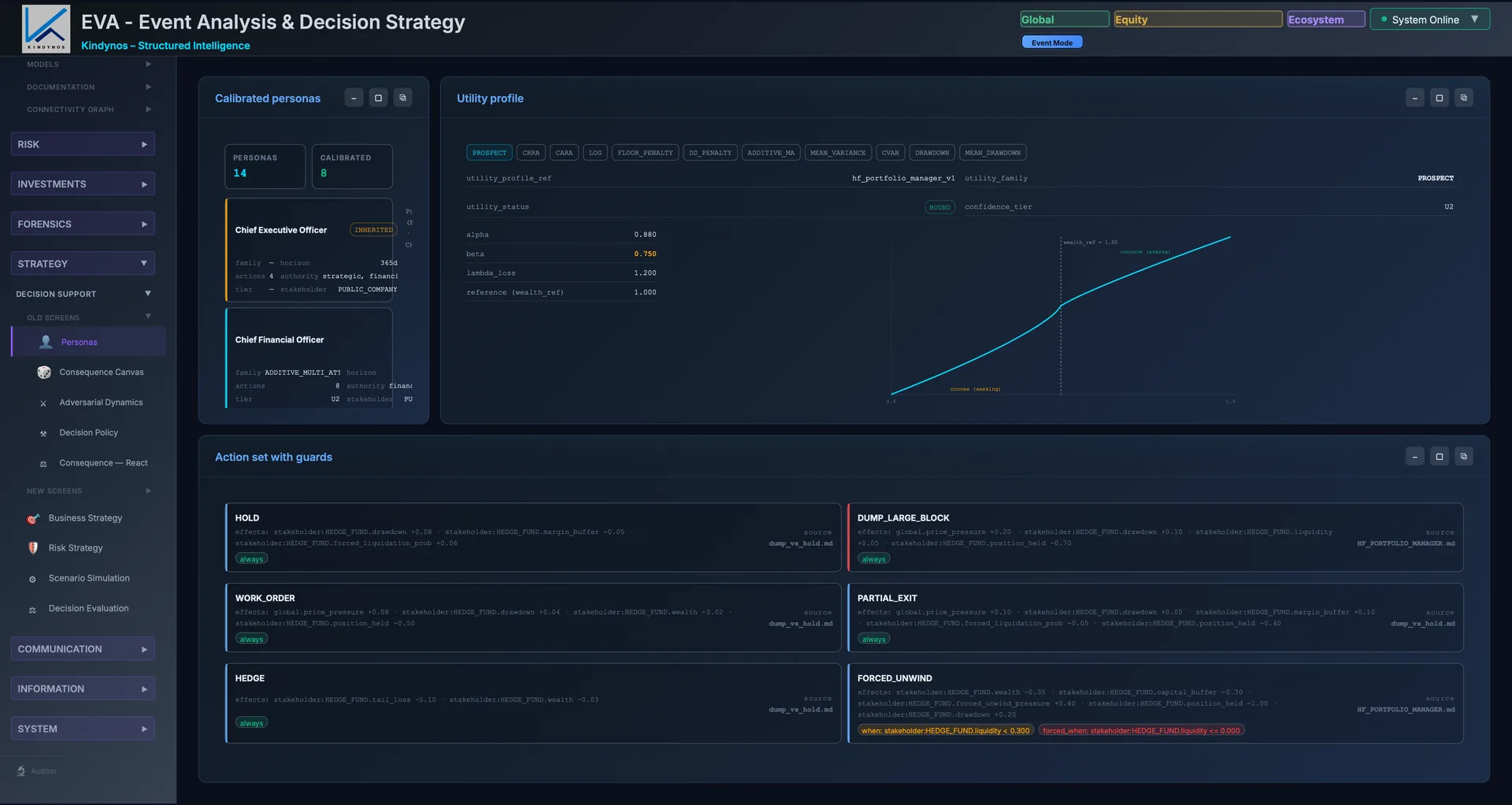
Persona calibration, a named utility family and guarded actions make the decision problem actor-specific rather than treating the institution as one homogeneous optimizer.
Open full capture ↗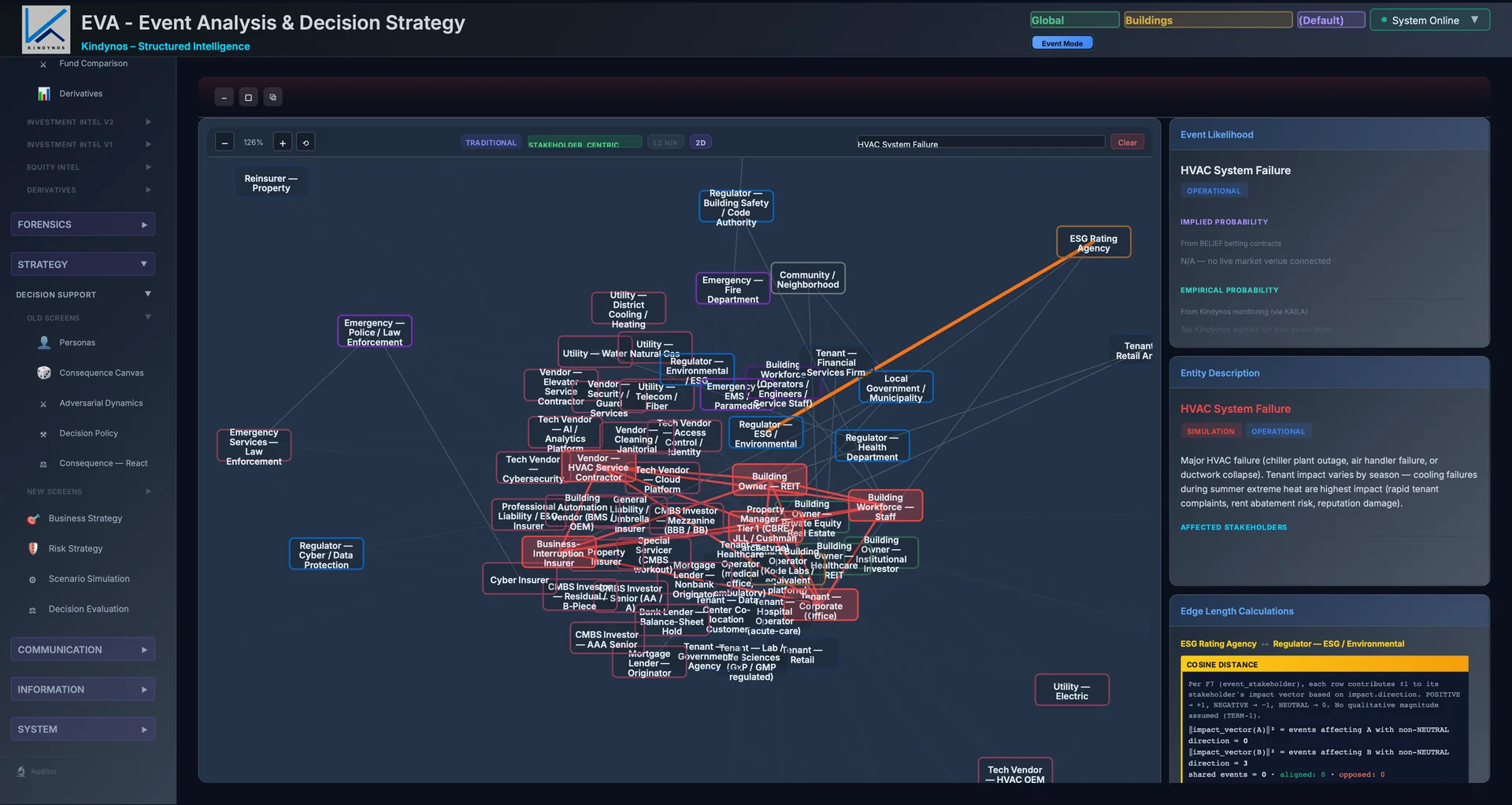
An HVAC system failure is located among owners, tenants, insurers, lenders, vendors, utilities, regulators and service providers before the impact analysis is run.
Open full capture ↗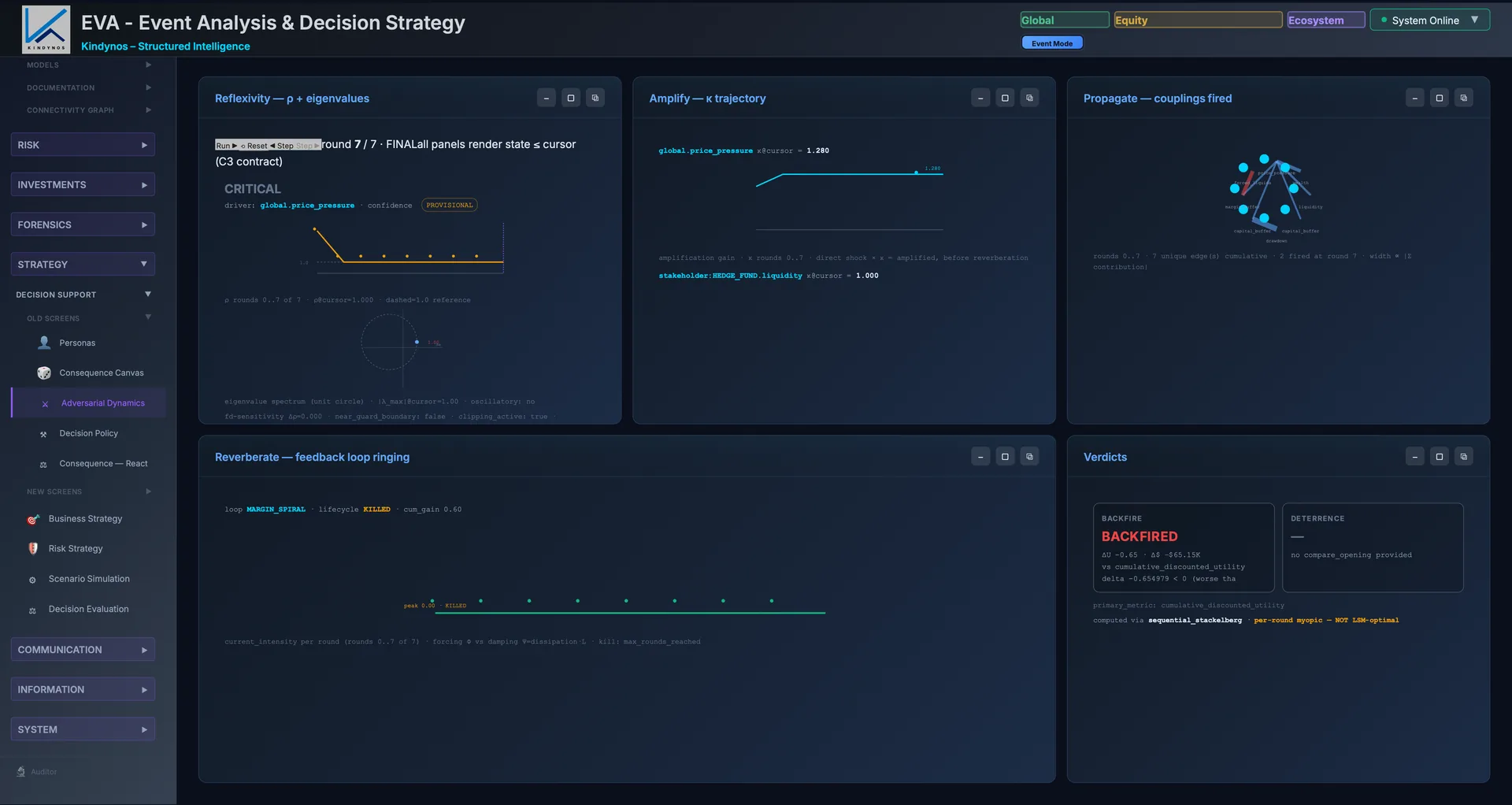
The interface exposes reflexivity, amplification, fired couplings and feedback-loop state, culminating here in a displayed BACKFIRED verdict for the selected path.
Open full capture ↗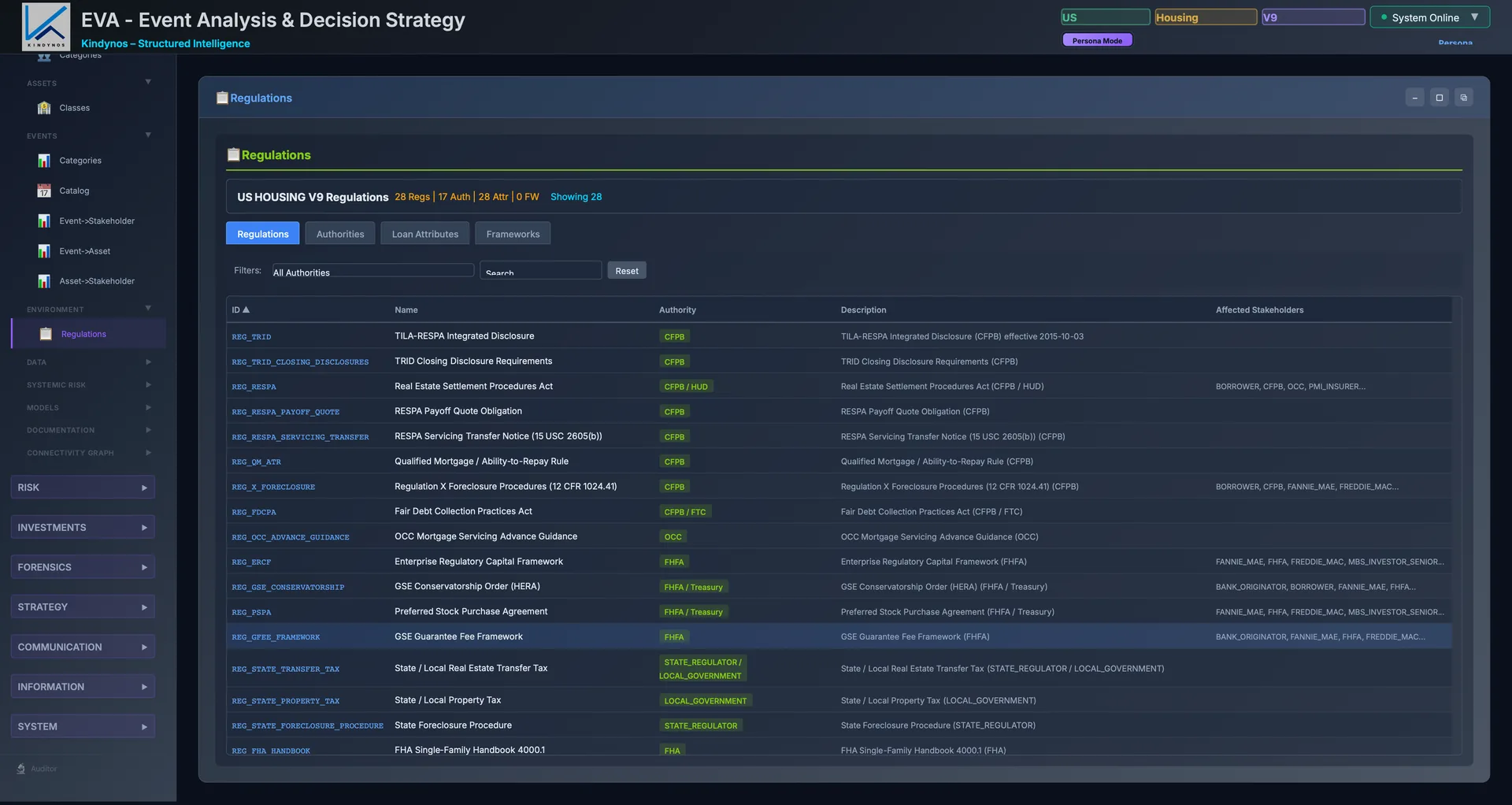
The captured registry exposes named authorities, regulations and affected stakeholders alongside the event and asset structures of the housing ecosystem.
Open full capture ↗The public page leads with useful functionality. Raw runs, replay records and technical verification remain available for readers who want to challenge the result.
Packaged execution captures exercise the governed firing path, preserve typed refusal rather than inventing a value, and demonstrate byte-identical replay on a named event sequence.
Bounded EOS/EPL examples show unavailable-backend refusal with no state commit, state carried through a sequence, and per-position values reconciled to a 50-position book total.
KAILA evidence covers deterministic signal identity, incompatible-version rejection, hash-chained artifact records and a stationarity check on the fitted calibration—not a claim of network transport or out-of-sample validity.
The execution module freezes a starting state, forks decision branches, applies interventions and verifies an append-only replay chain. Current reaction behavior is deterministic/scripted rather than a live autonomous-agent claim.
STAR's packaged v4 path turns an analytical bundle into claims, scene structure, render planning, identity and assembly metadata with deterministic replay. External media-provider rendering is outside this demonstrated path.
CRIS, DEFIANT and USRISK contribute bounded research-model demonstrations. They are useful evidence of analytical depth, but are not presented as integrated production application proof.
The public library will expand as the capability × ecosystem matrix is rebuilt mechanically, with versions and event paths underneath each cell.
Is this capability meaningful for this world, version and event path?
Do the registrations, routes, bindings and required models resolve—and has the path actually run?
Is there a named, reproducible result strong enough to support a public demonstration?
This prevents an attractive screenshot from being mistaken for universal coverage. The evidence library will grow from verified cells rather than forcing demonstrations into unsupported combinations.
For technical diligence, request the relevant execution artifacts, assumptions and world/version scope—or bring a consequential event of your own and define the path that matters.